Tjernlund Products Amazon Case Study: How a Legacy B2B Manufacturer Transformed Into a B2C Brand on Amazon
Tjernlund Products is an HVAC manufacturer founded in the 1930s that spent most of its history selling draft inducers and specialty exhaust products through regional plumbing and HVAC distributors like Grainger. Starting in 2013, two of the founder's great-grandsons, William and his older brother, built an Amazon arm inside the family business first selling on Seller Central as a third-party merchant, then transitioning to Vendor Central to sell directly to Amazon. Goat Consulting co-founder Will Tjernlund spent roughly two years building out that channel before leaving to help other manufacturers do the same thing. This interview, conducted by Goat Consulting CEO Reed Thompson in 2016, covers the full arc: the company history, the "rogue" Amazon experiment, the shift from Seller Central to Vendor Central, and the cultural and technical challenges of turning a 70-year-old B2B manufacturer into a B2C-first business.
History of Tjernlund Products
Tjernlund Manufacturing was started in the 1930s by Emil Tjernlund (Will's great-grandfather). Emil had a sheet metal background and designed hand tools for the trade, which morphed into designing and manufacturing forced-air oil furnaces for commercial establishments. Operations shut down during World War II, and a new company formed in 1947 that included Emil, his son Bob, and Bob's brother-in-law, Ed.
In the mid-1950s, the company created the Draft Inducer — a high-temperature fan installed in the chimney connector or main stack to boost draft, enabling the burner to operate more efficiently and safely. Draft inducers had more predictable sales than the feast-or-famine custom rooftop furnace business, and scrap steel from rooftop production could often be used to build draft inducer components. In the early 1970s, the draft inducer business broke off into a separate company named Tjernlund Products, and within a few years the rooftop manufacturing company was sold. For the first 30 years of Tjernlund Products, draft inducers and related specialty exhaust and ventilation products sold primarily to HVAC and plumbing distributors were the mainstay. Continual process improvements starting in 2007 reduced labor hours by 50% over the next five-year period.
The Situation When William Arrived at Tjernlund Products
Reed: So where should we start? At this time your dad is running Tjernlund Products, and your brother has just started working there. Pick up from here.
William: My uncle handed it off to my dad. My uncle has two sons who are also working in the business. The business was keeping on the same trajectory until they hired my brother. They hired him to help change the culture and mentality. They knew that he had some experience in e-commerce and had a fresh outlook on how business works.
Reed: What had the 10 years before that been like?
William: Fan-based stuff. They were still manufacturing the majority of what they were selling. They'd import motors and certain circuit boards from China, but the metal fabrication and assembly was still done at Tjernlund Products. The majority of people at Tjernlund Products were over the age of 45 and had been there 20 years on average. Everyone was kind of an expert at their own specific job but they had never looked at anything from an outsider's or completely fresh point of view. That was the reason why my brother was brought in there. He had a more current business school degree and more advanced knowledge of internet-based resources and sales. They called him College Boy when he first got there.
Reed: Who were they selling to at this time?
William: Most sales were to regional HVAC and plumbing distributors and to a few national distributors like Grainger. Smaller segments were sold to the engineering specification market and to specialty retailers.
Reed: How did your brother's background shape his thoughts on the potential he saw?
William: My brother's background is very entrepreneurial. He had been buying stuff from China via AliBaba for a few years, then selling finished goods on eBay and Amazon. He already had that mentality of, "Why don't we just buy a finished product and resell it for more money? Why are we trying to reinvent the wheel every time?"
Trying to invent something from scratch, get patents, get trademarks, make sure we have all the UL listing, the CE certification — this all sounded like so much trouble to launch a product at Tjernlund Products that might do $200,000 a year in annual sales, maybe $60,000 net profit.
Reed: He basically thought instead of focusing on manufacturing, how do we acquire finished goods easier and sell them on e-commerce marketplaces?
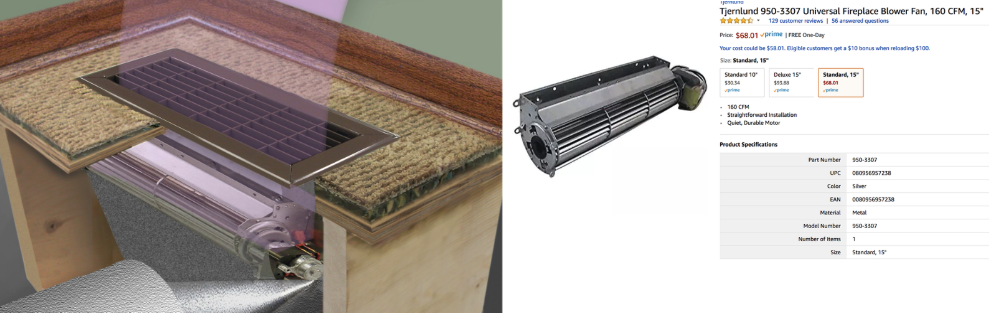
William: Yes, he wanted to sell straight to consumers. Tjernlund Products has a product called an RB10 Register Booster Fan — a blower that drops inside your register boot that boosts the amount of conditioned air entering a room. The fan inside of that is the same fan used for fireplaces to move air. He saw that the part they were buying for $7 was going as a finished good on Amazon for $90. That's where the first thought came from: "These somewhat unfinished products are actually finished products to other people."
Another example: a computer fan used for anything from cooling computers to cooling Bitcoin mines. The actual fan, when it comes down to it, is the same as the fan they already bought. The wholesale was $5; the retail was $20. Tjernlund was already buying 10,000 of these fans a year. If we bought 11,000, I'm sure I could get rid of those last 1,000 and make almost pure profit.

Tjernlund Products Assembly Line
Initial Pursuit of Selling on Amazon Through Seller Central
Reed: What were you doing while your brother was several years into Tjernlund Products?
William: It took him to his fourth or fifth year for this light bulb to come on. In the meantime, I was in college at the University of Minnesota Duluth, getting an economics degree and slowly following in my brother's footsteps importing products from China, selling them on eBay, Craigslist, and Amazon. The last half of my time in college was spent learning as much inside the classroom as outside, listening to e-marketing podcasts and audiobooks on how to build a brand, how to get backlinks, how to start and monetize a blog.
Reed: Was it always the plan for you to work for Tjernlund Products after you graduated?
William: No. I was close to graduating and asked my dad, "What's the deal with Tjernlund Products right now? Do you have a job for me?" He said my brother was starting an Amazon arm of the business and might need help. My brother thought this was a match made in heaven — someone he could trust, someone he could speak candidly to. Our age gap is large enough that we never even fought as kids. Starting December 2013, I was working full-time at Tjernlund Products.
Reed: What did that look like day-to-day?
William: At the time we had access to catalogs through the family business from different parts and companies. That was the lowest-hanging fruit. We'd go through the Amazon website and compare the products. We didn't have any third-party software we were just looking at reviews. "Hey, this has 100 reviews. We need to buy this. This thing sells like crazy." Even if something had only five reviews we'd say, "Okay, it's worth buying a couple."
Reed: Was this on Seller Central with FBA?
William: Exactly. We were taking small steps if something was selling $10,000 a month, we'd buy maybe $3,000 to make sure we didn't overextend. A container would land with 26 pallets. We would organize them into three shipments we'd pre-created in Amazon, label them, wrap and weigh, input the info into Amazon, and Amazon's 3PL would pick the pallets up that day or the next. My job for six months was unloading, organizing, labeling, restacking, and sending them back out. For the first eight months, everything was kept in our brains — which made training future employees harder since nothing was standardized.
Reed: Was the rest of Tjernlund Products still operating like normal?
William: We were rogue compared to everyone else. No one knew what we were doing. At one point we had done about $8 million in retail sales, and one of the engineers came back to the warehouse, saw me stacking boxes, and said, "Oh yeah, I heard through the grapevine you guys are trying to sell stuff on Amazon or whatever. How's that going for you guys?" That was the disconnect — a company that had done $10 million a year for 30 years straight, and now a new sales channel was roughly doubling revenue, and the majority of the company had no idea what we were up to.
Reed: How quickly did it scale?
William: Very quickly, because we had access to so much low-hanging fruit. HVAC is a very old-school niche lots of older men selling to their buddies through convoluted supply chains with multiple middlemen before the end consumer touches the product.
The biggest reseller of Tjernlund Products for the longest time is Grainger. Back in the day, someone would walk into Grainger saying, "My fan is broken on my CNC machine, I need a new fan." Grainger could get that fan within two days to a warehouse for pickup. For a fan that might cost $40 to make, Grainger would charge $400 because without that fan your press isn't running, and when your press isn't running you lose $10,000 a day.
It never made sense for some megastore to hold one of every fan for every press. The manufacturer drop-shipped for Grainger, and Grainger sold to the end customer. Before the internet, that's how manufacturers couldn't sell to the end consumer they didn't have access to distribution. Now someone takes a motor off their furnace, looks at the part number, Googles it, and buys it on Amazon. No questions asked.
We fulfilled things through Amazon, so we always won the Buy Box. These products were already being sold on Amazon but at high retail prices and merchant fulfilled. No one wanted to figure out how many to send into FBA. We did. If someone was already selling 10 of these dryer booster fans a week, and you make it Prime with free shipping, you win the Buy Box 100%.
Reed: Next step?
William: Getting out of our comfort zone. Eventually every HVAC product on Amazon was either sourced and sold by us or we had contacted the company multiple times. So we started selling products outside our core niche 3D filament for 3D printers, knee scooters, pour-over coffee stands, home safes. All sorts of random stuff.
The Transition to Vendor Central and a Hybrid Model
William: 2015 rolls around. I'd been working with my brother for a little over a year. I was getting burnt out after long days in a dark warehouse up in Northern Minnesota. It's manual labor, you work half the year in the dark, and sales kept going up, but for what? I wanted a lifestyle business — one I had 100% control over.
In January 2015, I went out to Australia for a week for a consulting job, came back to Minnesota for two days, then flew to Sonoma for another week of consulting. Instead of spending January in Minnesota, I was in beautiful tropical areas learning new businesses. I told my brother, "Hey, this is what I want to do. Let's give it six months."
The last few months of my time at Tjernlund Products were spent changing the business model from Seller Central to Vendor Central. We'd been dipping into Tjernlund's 70-year war chest of cash in the checking account to fund growth, and we'd reached about a $10 million annual run rate. We couldn't grow anymore just by buying and reselling — we needed to get more creative.
Reed: What is Vendor Central at a high level?
William: Vendor Central is selling to Amazon. Seller Central is selling on Amazon as a third-party merchant — you buy inventory, send it to Amazon, and cross your fingers hoping it sells. You take 100% of the risk. Vendor Central is the same as if you sold a product to Walmart or Target. You offer up your catalog at wholesale, and Amazon picks and chooses based on its algorithm what products it wants and in what quantities.
Reed: So Amazon becomes your wholesale channel?
William: Yes. Instead of getting paid every two weeks like on Seller Central, you generally get paid every 60 days on Vendor Central. From the outside that might look like it'd ruin cash flow, but for us the hardest part was picking winners and forecasting — getting stuck with the wrong inventory tied up a bunch of cash. Outsourcing that to Amazon, which has almost unlimited cash, made it easy to keep growing.
We made less margin per unit, but we could sell many more units. On Seller Central we peaked at maybe 1,700 products. On Vendor Central, my brother now sells hundreds of thousands of different products to Amazon. He only orders from the manufacturer exactly what Amazon has already paid for, so he's not floating inventory risk.
A silly, easy-to-understand example: say we buy iPhones from Apple for $500. On Seller Central we'd sell them for $1,000 — good money, but we're risking that a new iPhone launches, and we're competing in the Buy Box against everyone else. On Vendor Central, we'd sell that same iPhone to Amazon for $700. We only make $200 instead of $500, but Amazon wins the Buy Box every time and orders based on its own forecasting. We get steady, guaranteed demand without the inventory risk.
Reed: Really you're a glorified sourcing agent on behalf of Amazon is what it sounded like.
William: Yeah. If you look at Amazon from a macro level, they're launching more private label brands, they're selling more things under their umbrella. You can see where the market's going. It was just us getting ahead of it "Hey, why are we competing with Amazon in the Buy Box when they want to buy this product from us? Let Amazon handle what they're uniquely good at, and let us handle what we're uniquely good at: contacting brands."
The reason we exist is that certain companies don't trust Amazon. When my brother and I call them as a family business "Aw shucks, we're just trying to help you grow as we grow, no contracts" people feel a lot more trusting of us. When Amazon calls the same mom-and-pop asking for contracts and purchase orders the same day, they get scared off. We're the liaison who translates what Amazon actually wants into normal-people speak.
Leaving Tjernlund Products to Start Goat Consulting
Reed: How did you transition from freelancing to starting Goat Consulting?
William: I freelanced for about a year. I built an Amazon community forum website and sold it. I worked with brands and manufacturers, locally and internationally, and spoke at conferences but nothing was systematized. Each project was unique.
Around the summer of 2016, three larger companies contacted me within 48 hours. One did a little under $1 billion in revenue the year before. They all said, "We don't know if we'd call this a job offer or a contractor role, but we want you to manage our Amazon account."
I didn't have the bandwidth to run three Amazon accounts for large corporations solo. If I hired people and systematized, I could take on all three clients plus more I'd have my own company, decent income, and I'd get to do what I liked best: work with a bunch of different companies helping them become more efficient in the Amazon Marketplace.
Inefficiencies really bug me. Inefficient markets really, really bug me. Whenever things don't match up supply-and-demand-wise for some reason, that really annoys me. Being able to go and work with these companies, help them out, really do what I do best, help them send their business off into the next few decades, and then work with a new business — constantly solving new problems, working with new teams was exactly what I was looking for at this time in my life. I teamed up with you. That was the genesis of Goat Consulting.
Reed: What does Goat Consulting do now?
William: First, a lot of organization getting the catalog, prices, and photos all in one place. Then keyword research. Then rewriting the copywriting in a keyword-optimized fashion. We run advertising through Amazon Advertising services, helping brands and manufacturers spend advertising budgets to generate the greatest amount of sales. We don't do anything off Amazon no Shopify, no Instagram. We eat, sleep, breathe only Amazon.
Reed: Do you work with both manufacturers who sell wholesale and brand owners that sell direct?
William: Yeah, either. That's a perfect question for the first call with a potential client. A brand owner with one SKU they market hard, or a manufacturer with 10,000 SKUs we can work with both. Our A+ preferred client is an established, old-school brand that's the Lamborghini of their niche. One of our most boring, underlying goals is to make products easy to find and buy on Amazon proper photos, proper pricing, copy that describes the product. If someone can't search your product name and find it with those basics right, we've already lost the battle.
Advice for Manufacturers Considering an Amazon Transition
Reed: Do you think other manufacturing companies can copy your model, or use Amazon as a marketplace to be successful for themselves?
William: It comes down to risk tolerance. My brother and I did things in almost stealth mode do things and ask for forgiveness later. If we'd walked in with a full business plan to get to $10 million in 18 months, we would have scared the family off. Instead, we did it in a slow, step-by-step process, proving ourselves, and only investing again after we got our money back. That was an easier pill to swallow.
If I walk into a manufacturer and say, "Hey, you need to sell everything direct," the first thing they'll say is, "Our distributors don't want us to sell direct." Okay that's the first thing to work on. Talking to the distributors, figuring out how everyone makes money, making sure you don't underprice and ruin the brand.
Then: "How much cash do you have to invest in new products you're not currently sourcing? You have 10,000 products you could be sourcing, but you only buy 50 of them for your manufacturing plant. Which of these are you willing to take a risk on?"
It's risk tolerance first. Are they willing to call their suppliers and say, "We want to sell direct to Amazon"? A lot won't. If they are, how much cash can they risk? We can do baby steps. Or we can go fast. Or they can keep doing B2B and dip their toe in but you're not going to get the full benefits of B2C until you jump in headfirst.
Reed: So strategically you can get everything right, but operationally there are different ways to cut it.
William: Exactly. And it's dealing with the culture. Business owners say, "You don't know what the scooter industry is like. We all know each other. If one person sells direct on Amazon, their whole business is out of business." It's a common theme. Explaining that the sky is not going to fall if you sell directly is part of the job. If you can show going direct is actually best for the consumer, best for the brand owner, and everyone wins the customer gets it at the lowest price and fastest possible then the people who add value in this world get the most profit.
My whole thesis for Goat Consulting, working with Tjernlund Products, everything, is: how do we get rid of middlemen who aren't adding value? Middlemen who keep product on a shelf, explain variants, let customers touch and try they're providing real value. In this day and age, that's becoming less common. As retail stores keep less in stock and employees know less about specific products, it makes more and more sense to buy directly from the brand or manufacturer.
Cultural and Technical Challenges of a B2B-to-B2C Shift
Reed: Tell me about Tjernlund Products today. Is it still just your brother unloading trucks?
William: My brother runs the majority of the company now, and it's about 80/20 Amazon to traditional manufacturing. He has a full team — maybe 10 or 12 warehouse people, two admin, one customer service person, one person writing copy and uploading listings, plus a small army of virtual assistants doing spreadsheet work. Overall, around 14 people.
Reed: It sounds like nobody got fired. Everyone got cross-trained.
William: Yeah, exactly. It was begrudging at first the boss's son comes in and says, "Here's what you're going to be doing." They'd been doing the same job the same way for 30 years. But slowly they understood: "This is what the company does now. We're moving full-bore into Amazon. If you want to continue here, we have a million things to cross-train you into."
One guy refused said he wasn't going to learn, wasn't going to cross-train. He no longer works there. Most people, after a while, were actually pretty open to trying something new and learning new skills.
Reed: There can be cultural challenges with new ventures, but sometimes it's needed to stay alive.
William: Exactly. And we had a unique workforce. A decent number of people in the factory at Tjernlund Products don't have cell phones or internet at home. That makes even training on Amazon on a computer much more difficult. You and I know that right-click gives more options than left-click, but that's not apparent to everyone.
Another example: watching someone in shipping write down a tracking number on a Post-It and walk across the factory to give it to someone else to input for the customer. You just copy and paste you skip a step, you don't mess up writing it down. Little things that seem like common sense when you use a computer every day.
Our inventory management system was another issue 25 years old with zero APIs. The traditional system had a piece of sheet metal as part number 101. Once bent twice, it's 101B. Once bent again, it's 101C. 101C plus 102B together equals a crawlspace fan. Parts, then fabricated parts, then finished goods. Retrofitting that to handle finished goods on Amazon was difficult. The software is so old you can't even use a mouse on it everything via keystrokes. They're still having problems with it today. I think they have to fully phase out the manufacturing side before they can change the inventory management system.
Reed: Where do you see the future for Tjernlund Products?
William: Continue being a glorified sourcing agent for Amazon. Amazon now has vendor managers who tell them specifically, "Go contact these brands." I think there's room to do that for the next five to 10 years. From there, we'll have thought of the next logical step.
I need to know where consumers are going next who the up-and-coming marketplaces are, how consumer behavior is shifting. Knowing those things a few years ahead of everyone else lets me guide my family's company, our clients, and our agency in the right direction.
Reed: Anything else?
William: No, besides that I hope I didn't scare anyone off. There are some things you need to deal with between the software, cultural, and risk-mitigation, but in the end it was super beneficial for us. You can take each baby step along the way, and make sure that each step is provable and profitable before you take the next one.
Key Takeaways for Manufacturers Considering an Amazon Transition
The Tjernlund Products story contains several lessons that apply to other legacy B2B manufacturers weighing an Amazon channel.
Start with your existing catalog, not your imagination. The Tjernlund Amazon business began by buying through the family's existing supplier relationships and reselling into Amazon Prime. No new SKUs, no R&D cycle, no UL certifications to chase just finished products other brands already made, offered with better fulfillment than the existing Amazon sellers.
Finished goods live inside your parts list. The RB10 Register Booster Fan insight that a $7 internal fan is a $90 finished fireplace blower to a different consumer is worth searching for in your own catalog. Manufacturers often buy components in volume that are someone else's retail-ready product.
Seller Central teaches you the marketplace. Vendor Central scales you through it. Seller Central lets a manufacturer learn Amazon with limited SKU and cash risk. Once volume and forecasting become the bottleneck, Vendor Central lets you outsource inventory risk to Amazon, accept lower margin per unit, and multiply SKU count.
Risk tolerance determines pace. The Tjernlund brothers moved in small, provable increments because a single-shot $10M business plan would have scared off the family. Baby-step approaches are available to manufacturers that aren't ready to jump in headfirst.
Cross-train rather than replace. Tjernlund Products transitioned most of its existing workforce into Amazon-supporting roles rather than cutting headcount. A 70-year manufacturing culture can absorb a B2C channel, but leadership has to show what the new roles look like.
Wrapping Up the Tjernlund Products Amazon Case Study
Tjernlund Products is proof that a legacy B2B manufacturer can add a meaningful B2C Amazon channel without walking away from its existing distributor relationships or its manufacturing floor. The playbook Will Tjernlund developed inside his family's company source existing catalog access, start small on Seller Central with FBA, scale through Vendor Central to outsource forecasting — is the same framework Goat Consulting uses with manufacturers and brand owners today.
If you run a manufacturer or brand considering an Amazon channel or if you're already on Amazon and trying to decide whether Vendor Central, Seller Central, or a hybrid model fits please reach out through our [Contact Us](/contact-us) form.
About the Author
This post was written by Reed Thompson, the CEO at Goat Consulting, based on a personal interview with Goat Consulting co-founder Will Tjernlund. Reed helps lead the Goat Consulting team and their clients sell on Amazon by increasing sales, mitigating risk, reducing costs, and solving problems. If you want help transitioning your manufacturing or brand business to Amazon, please reach out through our contact form.