If you sell on Amazon, you may be hearing more about two-dimensional (2D) barcodes, product serialization, and Sunrise 2027. But what does it all mean for your brand? And what would switching actually involve? We sat down with Andrew Morehead from GS1 US to talk about GS1's partnership with Amazon Transparency and work through those questions. We cover what's optional, what to consider before making changes, and how 2D barcodes can help with everything from product authenticity to supply chain visibility. Whether you're looking into Amazon Transparency or just getting familiar with 2D barcodes, this conversation is a good place to start.
Eric Sutton, the Operations Manager at Goat Consulting, speaks with Andrew Morehead, Director of Global Standards at GS1 US, about GS1's partnership with Amazon Transparency, product serialization, 2D barcodes, and what these developments mean for Amazon sellers.
How GS1 US and Amazon Transparency Work Together
How did the GS1 US and Amazon Transparency partnership start?
Eric Sutton: Andrew, thanks for joining me today. To kick things off, could you provide a general overview of how this partnership got started with Amazon Transparency? What is GS1's role, and how do you work together?
Andrew Morehead: Thanks for having me. Happy to be here.
GS1 US has a program called the Solution Partner Program, and Amazon Transparency is one of our solution partners.
What they provide to brands and manufacturers is a way to serialize using GS1 standardized formats. The Global Trade Item Number (GTIN), which some people know as the Universal Product Code (UPC) or European Article Number (EAN), identifies the product. You can have a multitude of products all over the world that have that same GTIN.
But to identify the specific product (let's say a can of soda), each can made on the manufacturing line can be serialized and have a different serialization number.
Amazon Transparency has been offering a serialization process for authenticity and many other use cases within its distribution channels for a while. Now they have started to use GS1 standards, which provide the format for how that information is encoded or put into a 2D barcode.
The partnership is that they take the GS1 standard used globally and build upon it as it pertains to 2D barcodes, GS1 Digital Link, and Sunrise 2027.
Are 2D Barcodes Required for Amazon Sellers?
Does Amazon or GS1 require a 2D barcode to keep a listing active?
Eric Sutton: Let's cover what the seller actually has to do to incorporate the benefits of this partnership. Is there any point at which Amazon or GS1 requires a 2D barcode to keep an active listing, or is this optional for third-party sellers? Basically, is it a requirement or optional?
Andrew Morehead: It's optional because GS1 standards are not mandatory. They're voluntary. You can continue to use a linear barcode, or a one-dimensional (1D) barcode, in your supply chain processes.
But to do business with Amazon, you have to have a GTIN that has been licensed through a GS1 member organization. Amazon, like many retailers, e-commerce platforms, or sellers doing fulfillment, could make its own rules or mandates around what information it wants and how it wants to receive that information.
It could start to require only 2D barcodes because they can hold more data than just the GTIN. The serialization aspect is very important.
What happens if a seller does nothing before Sunrise 2027?
Eric Sutton: Looking ahead to Sunrise 2027, if a seller does nothing through 2028, what specifically stops working? Is it listing creation, Fulfillment by Amazon (FBA) receiving, or retail expansion? Is nothing affected? Could you expand on that?
Andrew Morehead: Because GS1 standards are voluntary, not mandatory, nothing changes. You can continue to utilize that linear 1D barcode throughout your entire supply chain and continue doing business as usual.
The things you'll have to be aware of are the different regulations taking place globally, and specifically within the US, that require additional pieces of information to add traceability and visibility in the supply chain.
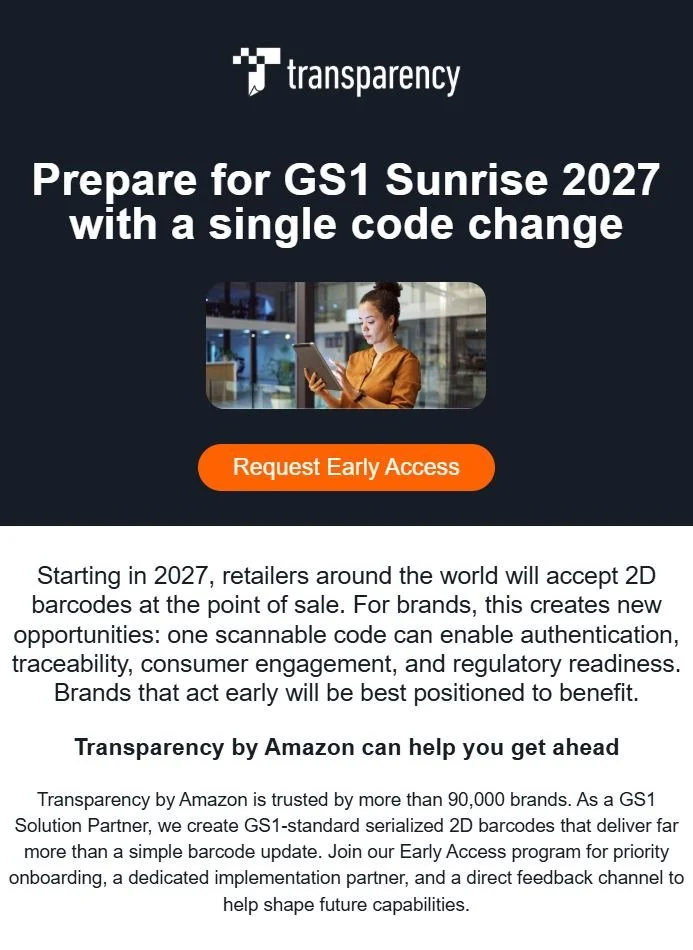
To level-set Sunrise 2027, the bare minimum capability to be ready as a brand or manufacturer is to have the GTIN inside a 2D barcode using GS1 Digital Link or another syntax (machine language) known as GS1 element string syntax.
Those are the ways GS1 product identification data can be encoded or put into a 2D barcode and remain interoperable between systems globally.
If you're selling in the US, Spain, or Brazil, those products will be able to scan and still go "beep" at checkout.
The bare minimum is having that GTIN, that product ID that many people know as the UPC or EAN. You can continue to use the lines and spaces of that linear barcode. By the end of 2027, retailers are expected to be able to scan the 2D barcode, and it will go "beep" at checkout. You'll get a price and be able to scan yourself out, doing what you're doing today with a 2D barcode. That's what Sunrise 2027 is.
From there, you're able to unlock different use cases and capabilities, like serialization, stopping expired products from leaving a retail environment or distribution center, or tracking specific items in the supply chain for recalls with a batch/lot number.
There are so many things that 2D barcodes unlock. Many brands are moving extremely fast because they want to start taking advantage of those use cases. They have to start properly implementing how the barcode can work in their supply chain today, as well as in retail environments at checkout or when consumers scan it with their mobile phones.
There's no sunset. There's a sunrise. Nothing will break. But as more requirements come into play, you may have to rush your process to meet those requirements for additional data.
Eric Sutton: That makes sense. I definitely see the value in serialization for expirable products and cost control throughout the supply chain. Knowing exactly what inventory you have, its condition, and its age is huge.
Is Amazon Transparency the Only Option for Serialization?
Is Amazon Transparency enrollment required for Sunrise 2027 readiness?
Eric Sutton: Is Amazon Transparency enrollment becoming a practical prerequisite for Sunrise readiness on Amazon, or is it one among several options? Is it the only option for compliance, or are there options through GS1 without using the Transparency program?
Andrew Morehead: Depending on what regulatory requirement you're trying to comply with, there are a multitude of solutions if we're talking about serialization.
Amazon has been providing serialization for its products for a while. When you've been ordering products, there may have been an Amazon Transparency code on them. From my knowledge, one of the things they were combating heavily was product authenticity.
The last thing they wanted was for their brands to get a bad reputation because a bad actor put a product in their supply chain with the brand's name on it, utilizing its data, but the product had defects or was not safe.
It's about ensuring that the products they're receiving are the actual products that come from the manufacturer and brand, and that those same products get to consumers. They're addressing that liability through serialization.
They've been doing this for a while. Now that they're doing it with GS1 standards, it makes implementing serialization a lot easier.
There are many other solution partners already offering serialization services, even for radio-frequency identification (RFID) tags. It's not the only option, and there's no compliance requirement around it in itself. But if it's something Amazon requires for its sellers, then Amazon is providing a way to comply with its rule.
It all depends on what retailers, distribution centers, and third-party logistics providers (3PLs) are asking for. If they start to ask for specific data, tell you they need a 2D barcode, or tell you they want serialization, that's where brands will have to start changing their processes. To do business with them, they have to abide by their rules.
We're seeing that happen across different advanced data carriers, like RFID and 2D barcodes.
Eric Sutton: It's almost like the whole environment needs to gain momentum. As additional systems start using it as a default, it's going to become more of a requirement, not only from a compliance standpoint but from a functional standpoint.
Andrew Morehead: We call it an imminent need. Data is king. More people want more data, and businesses want more data. It's already happening, so it's an imminent need at this point.
The Benefits of 2D Barcodes for E-Commerce Brands
What do 2D barcodes offer brands that sell only online?
Eric Sutton: Many of our clients and Amazon sellers in general may distribute only through Amazon and not be present in brick-and-mortar stores. For those businesses, could you expand on the benefits of adopting a 2D barcode from an e-commerce perspective? What additional information and value do they get?
Andrew Morehead: There are so many benefits I could go over as they pertain to 2D barcodes, but I think the main one is having that end-to-end traceability.
You're sending your product, making sure it's received by Amazon, and allowing Amazon to easily fulfill orders to consumers purchasing through its platform.
Having that end-to-end traceability gives you a story of your product from conception all the way through to the consumer's hands, when they're scanning it at home or after they've purchased it.
You can do that today with 1D barcodes, except consumers aren't scanning 1D barcodes to have an interaction. To provide the amount of data that would give you that visibility, you could have a multitude of 1D barcodes, but that's not feasible or efficient for your supply chain. It needs to know which one to scan because your scanner is going to grab one.
If you're using machine vision or automation, it's going to grab the first barcode unless you're putting money into upgrading those systems to be more robust. Many cameras, systems, and scanners within the supply chain today are image-based scanners, so it's not necessarily a big lift. Having multiple 1D barcodes instead of one 2D barcode containing all the data is more of a headache.
The 2D barcode is also more resilient in the supply chain. If it gets scratched or damaged, it can still scan, and you can still get the data. With a 1D barcode, as soon as it's damaged, you may have to go back to typing in the number.
There are many ways a brand or manufacturer can benefit from 2D barcodes just by connecting its product to the internet. It's called connected packaging.
When somebody scans it, you can change where the destination goes for the consumer or your downstream partners based on different connections for sharing data. That allows the variability of the internet to come to your packaging.
A lot of major brands have already implemented it. Small brands are also in the process of doing it because it's easier for them. They don't have a large catalog.
Eric Sutton: To contribute from my end, smaller brands may ask, "Is this overkill? Do I really need to do this?" But executing it is a lot simpler for them at the same time. Even if it might seem like overkill or not that useful, people will see the use once they start using it, and it's often easier to roll out in a smaller business.
From an Amazon FBA standpoint, I see serialization as building additional product trust. The storytelling capabilities of a customer being able to scan that barcode, and the brand being able to communicate attributes or information through that interaction, are hugely valuable, especially when brands and sellers may feel their ability to connect with customers is limited when selling through Amazon.
I think that's a really impactful touchpoint.
Beyond that, from a cost standpoint in FBA, it can often feel like a black box when you inbound inventory, and it's not always first in, first out. From a product expiration or unit condition standpoint, there are different unit health factors that need to be considered and weighed. This provides insight into that.
Lastly, on your point about scannability, we often see that packaging and how the barcode is applied can affect whether it's readable and scannable. Another benefit of the format is making sure it scans correctly a higher percentage of the time.
FBA Preparation, Receiving, and Inventory Visibility
Will Amazon fulfillment centers scan 2D barcodes instead of 1D UPCs?
Eric Sutton: Let's expand on FBA prep and receiving, and the benefits of 2D barcodes there. Will fulfillment center receiving scan the 2D barcode in place of a 1D UPC? What's the timeline for that? I'm specifically asking about Amazon fulfillment centers, but feel free to talk about other channels if you have feedback.
Andrew Morehead: A lot of 2D barcodes are already being utilized in general distribution in proprietary ways. Companies are putting their own data inside because it's an easier barcode to scan.
A lot of them are also gearing up for receipt accuracy. That includes Amazon, Walmart, other e-commerce platforms, and distribution centers. They're seeing that a 2D barcode holds additional data and is easily scanned, making it useful for shipping and receiving.
It will use the same sharing of data that's being done today with electronic data interchange (EDI) messaging, the Serial Shipping Container Code (SSCC), and the other information for your logistics units.
Having additional information means that when a product is sent to and received by Amazon, they can scan that barcode to say, "Yes, we got those," "We got a portion of those," or "We didn't receive it, so we weren't able to scan it."
From there, you're able to see gaps happening in the supply chain before the product even gets to Amazon.
There's also retail theft, which has been growing. There are different ways to address that using 2D barcodes coupled with RFID, so you're getting a better view of where those products are in real time.
Connecting even your logistics units to the internet through GS1 Digital Link allows more visibility, ensuring products weren't tampered with and serializing them before they're even palletized. All of this is information Amazon would scan into its facility to ensure it's getting those products.
The first-in, first-out process you were talking about requires date sensitivity for things that can expire or are no longer usable after a certain time. Those things can be put into a barcode as well. After receiving the inventory, they can properly put it on shelves to keep that first-in, first-out motion going.
Transitioning from 1D to 2D Barcodes
How should sellers handle existing inventory with 1D UPC labels?
Eric Sutton: Amazon Transparency already blocks commingling. One hesitation we hear from sellers considering Transparency, especially those with wide distribution, is that they have all this inventory distributed with 1D UPC labels.
It seems like a big hurdle to work through that inventory across the supply chain and then start manufacturing, labeling, and distributing 2D-labeled units so everyone has them and it's uniform.
Do GS1 serialized 2D barcodes extend that? In your view, is that a feature or a cost for sellers with a mixed supply chain, where there may be a transition period to work through old labeled inventory before moving to the new system?
Andrew Morehead: There's definitely a transition period for getting through inventory that won't have 2D barcodes.
When you're talking about a large catalog versus a small catalog, with larger catalogs you'll want to look at the products that are more suited to transitioning now. They may have more space on their packaging, so you can have dual marking with both the 1D and 2D barcodes as they go through the supply chain, even if they're being sold through Amazon.
Having that dual-marking requirement ensures that if systems haven't been updated properly in other portions of your supply chain or other parts of the world, they can still fall back on the 1D barcode.
Then you need to figure out how you want to put that barcode on. It's easier with a few products because you'll get the process down: who has to be involved, who's creating it, who's printing it, who's applying it, and what inline printing looks like, especially with dynamic or variable data.
There are all these things you have to look at to make sure you're not disrupting the supply chain in one portion of the country where product turnover is faster compared with another portion where the product moves more slowly. If you're talking outside the US, there's that whole aspect as well.
Eric Sutton: That's another reason I see this being easier for smaller businesses to execute: the control and awareness of where everything is, knowing when the 1D-labeled UPC inventory is out, and making that transition more quickly.
Brand Control Over the Scan Experience and Product Data
Can a 2D barcode send shoppers to the brand's own website instead of Amazon?
Eric Sutton: Let's talk about data ownership and how brands can leverage the 2D barcode scan experience. Could you speak more about the control brands have over what appears when the barcode is scanned?
To clarify for listeners and readers, can it go to the brand's own direct-to-consumer site versus an Amazon.com detail page? What's the flexibility?
Andrew Morehead: There are many ways a 2D barcode can be encoded. If it uses the brand's domain name, the brand is in control.
One consumer scan of a Quick Response (QR) code with Digital Link could go to one experience. If the brand is trying to provide multiple experiences, it can go to something called a link set, which many people will recognize as being like Linktree: you go to a landing page, and there are multiple things to choose from.
That's what a lot of brands control: whether it goes to one page or multiple pages.
If they want to change the experience for a barcode that was part of a specific batch that got recalled, they can ensure that when a consumer scans it, they get a notification saying, "This product was recalled. Return it to the store, and we'll give you another one," or "Please stop using it."
They're in control of those digital experiences for the consumer. Most of the time, they're going to utilize a solution partner because that's a lot of different experiences to try to provide in-house, especially when they're also creating the product.
Some companies try to create it in-house and do it on their own without a third party. Whether they utilize a third party to manage those experiences or not, the brand is going to be in control of the consumer experience.
With general distribution, they would set up something like application programming interface (API) connections to data pools, such as the Global Data Synchronization Network (GDSN) or GS1 US Data Hub, and pull data directly from the areas where it's being sourced. Within general distribution, they can scan it and get additional information.
You don't have to have all your data in one barcode. You can have the most important data in the barcode (your GTIN and serialization number). Then, when it's scanned in the supply chain by handheld scanners, automation, machine vision, or whatever is being utilized, it can link that Digital Link with the GTIN and serialization number to the rest of the information.
That could be the batch/lot number, expiration date, manufacturing date, or country of origin. All these things can be linked to online without being put directly in the barcode.
That helps ensure good print quality, and all your downstream partners will have access to the data. You'll get two different experiences based on whether it's a consumer or your downstream partner, and the brand owner will be in control of that data.
If you're working with a third party that's creating your Digital Links, that first entry point for a consumer scan is something brands would discuss with Amazon Transparency or another solution partner. General distribution would still work the same way around sharing data.
How do 2D barcodes give brands visibility into scans and distribution?
Eric Sutton: When a lot of people think about a scannable barcode, they think about the customer's point of view and use case. But to your point, there's just as much or more value on the fulfillment partner side, scanning it at different stages of the supply chain.
We know that maintaining attributes and pushing product data into different channels and marketplaces can be difficult when formats and requirements vary.
Tying those core attributes to the 2D barcode record can help pull that information into the marketplace when the unit shows up. It's not that you don't have to worry about setting up the product record to support the unit, but the unit can stand on its own and communicate what it is when it's scanned, which is huge.
Andrew Morehead: Exactly. Visibility of the scan also goes to the brand owner. Anytime the barcode is scanned, they can see that in the same way they can see somebody visiting their website. They can see that somebody visited from a specific or general location, or a virtual private network (VPN) location.
Eric Sutton: Another thing I would point out on the supply chain topic is that some of our clients and sellers have distribution through multiple partners selling their products on Amazon.
They may have wholesale orders on hand and on record, but they're not sure what's happening between the wholesale sale of the inventory and its arrival at the customer's doorstep.
I think this provides a huge amount of visibility into that current blind spot. Where is that unit traveling? Is my distributor the one turning around and selling it to the end customer? Is it going through another two intermediary parties? It provides a lot of valuable visibility.
Andrew Morehead: It does.
Using the Same Packaging Across Amazon and Other Retail Channels
Will a Transparency-linked code cause problems at Walmart or other retailers?
Eric Sutton: Let's talk about other marketplaces outside Amazon. For a seller running one package across Amazon, Walmart, and other retail channels, does a code tied to Amazon's infrastructure and this Transparency partnership create problems at those other destinations?
Andrew Morehead: It shouldn't, because they're using GS1 standards.
When encoding the GTIN and serialization number, it's the same way they would have encoded it if they sent it to any other channel utilizing GS1 standards.
That's where the beauty of using something interoperable comes into play. It's not just going to work at Amazon. It can work at any retailer or on any omnichannel platform.
Eric Sutton: The universality of GS1 has always been a huge benefit in my mind. It provides peace of mind knowing that the work you're doing with GS1 will provide benefits wherever you decide to expand.
Andrew Morehead: Exactly.
Do sellers need separate labels for each sales channel?
Eric Sutton: Is there any chance that a competing retailer objects to the code's domain? Would the seller need to package or label stock keeping units (SKUs) separately by channel? Are there any domain or channel conflicts users should be aware of?
Andrew Morehead: Not that I'm aware of today.
Many brands already have 2D barcodes on their products using GS1 Digital Link, and those sometimes go directly to a recipe or the brand's page.
There is something called geofencing or geolocation that the brand can implement in conjunction with the retailer to give specific information when someone is inside a retail environment.
For an omnichannel or e-commerce platform, the numbers inside using GS1 standards would be what every downstream supply chain partner utilizes. The consumer scan experience would be provided by the brand for the consumer.
There can also be specific experiences provided by the 2D barcode within a certain location.
Counterfeits, Returns, and Disputes
Eric's experience: serialization, counterfeits, and customer claims
Eric Sutton: Let's turn our focus to counterfeits, returns, and disputes. Fraud prevention and product authenticity are the core values communicated around Amazon Transparency.
I can speak from my experience about how Amazon Transparency and GS1 use can help prevent counterfeits and resolve customer claims.
First, there's blocking and preventing counterfeit inventory that isn't Amazon Transparency- or 2D-labeled from being received in the first place, stopping it at the door before it gets the chance to be stocked and sold to customers.
Then, in the case of A-to-z claims or return fraud disputes on Amazon, customers may fraudulently claim they returned a product when they didn't, or say the product wasn't authentic to how it was described on Amazon.
Serialization can provide evidence through barcode scan events that a product was never shipped back. That's useful information in a return process or an A-to-z claim.
We can see that the legitimate unit tied to that product data is the exact one shipped to and received by the customer. It provides concrete, real-world proof that helps clear up some of the uncertainty that can cause trouble when resolving these claims after an order.
I think that value is huge, especially if you sell a product with a high rate of those issues. For high-fashion brands or products that people counterfeit at a high rate, it makes this more appealing. If you sell a product with a high return rate, that increases the likelihood of return problems or fraud disputes, and this provides clearer information for resolving them.
Can serialization data support FBA reimbursement claims?
Eric Sutton: Can serialization data support FBA reimbursement claims or prove that a returned unit wasn't the one shipped? I think I addressed that in my previous comments, but do you have anything to contribute, Andrew?
Andrew Morehead: I would say serialization is an added aspect because the first thing it's being identified with is a Serial Shipping Container Code, which is a GS1 primary identifier.
As it pertains to items shipped into Amazon, they're going to receive them or not receive them depending on the GTIN. They may receive them at the dock, but they might not start stocking their shelves and fulfilling them if the GTIN didn't come from a GS1 member organization like GS1 US.
There's that first portion. The serialization is what's done by Amazon. They're creating their Amazon Transparency codes.
When it comes to serialization, it may be created within their fulfillment center for shipment to the consumer, allowing that authenticity to be accounted for from when it was shipped.
I'm actually not sure on this next point: whether Amazon Transparency is creating the Transparency codes utilizing the GTIN and serialization for them to put on their products. There may be some portion of Amazon creating products in a facility, because there's so much Amazon does that I'm not aware of.
Prior to products coming in, manufacturers can get the serialization number from Amazon and print it in a GS1 Digital Link. It has the Transparency serialization number in it, but it still utilizes the same standardized barcode format.
There are different ways Amazon may provide it: on products when they get to the facility, or by providing serialization for the GS1 Digital Link to go on products as they're manufactured, before they're sent to Amazon.
They'll have almost a log of what those are. That's how providing serialization as a solution provider would work: creating the serialization number and giving it to the brand or manufacturer to put on the product with the GTIN.
It's about what the brand wants and how it's trying to take advantage of that solution.
Why Serialization Should Start at Manufacturing
Why do Transparency codes need to go on every unit manufactured?
Eric Sutton: One final point on Amazon Transparency and GS1 serialization: enforcing distribution agreements, or what you as a brand want your distribution to be on Amazon, can often be frustrating. Brands and sellers want control over pricing and who can offer their products.
We often see a misconception that Amazon Transparency is a tool for providing privileged distribution access to specific parties.
For example, you may have 15 sellers offering your product but only want two approved parties to offer it. Sellers may think, "I'm going to enroll the product in Transparency and only provide these serialized barcodes to the two approved parties I want to move forward with."
Then, when the listing transitions to Amazon Transparency serialized barcodes only, they expect the other parties to get pushed out and distribution control to be achieved.
But we understand that the Amazon Transparency program terms state that these serialized barcodes need to be applied to every unit manufactured. It's not something that can be selectively applied to stock for specific distribution channels.
For the serialization benefits we're discussing to occur throughout the supply chain, it needs to be universally applied to every unit manufactured.
Could you expand on why it's important to apply these at the manufacturing step to every unit going out the door, even though selectively labeling inventory might seem tempting, convenient, or easier than changing manufacturing practices?
Andrew Morehead: It's very important to apply it at the manufacturing point. Remember when we were talking about end-to-end traceability? You'll be able to view that product from conception all the way through to the consumer's hands, post-sale.
Because you have that GTIN and serialized GTIN in one barcode at the time the product is manufactured and the barcode is created and applied, you get visibility from it leaving the manufacturing facility to any location it went before getting into the consumer's hands, and even after that.
That's the benefit of implementing it on a manufacturing line.
If they're taking advantage of Amazon Transparency just by selling through Amazon, that's another thing. The same applies if another company or e-commerce platform does it. That may be for managing inventory with Amazon: "We shipped you these things." They're putting Transparency codes on immediately to show that it's an authentic product and that they've verified it.
When they ship it from their fulfillment centers, that solution addresses authenticity for a consumer who might question whether the product is authentic. They got it from the manufacturer, immediately marked it, and sent it to the consumer.
There are ways to fight counterfeits. But if they put it on at the point of manufacturing, when the product is created, you get a view of the product's entire journey through the supply chain. I think that's the greatest benefit for a brand or manufacturer.
Eric Sutton: I wanted to bring that up because it's often something that pops into brands' or sellers' minds. They may have a key problem with one product, one distribution channel, or a single distribution party and think, "I'm going to selectively apply these 2D barcodes to this situation because it seems convenient. It's a shortcut that can fix this immediate problem."
But a lot is lost when you don't go upstream and take the time to apply it through the entire supply chain.
Andrew Morehead: It's best to have everybody involved on your team or within your brand who's going to be creating this code, so they're aware of what they're getting out of it.
Marketing is going to get something out of this. Whoever is creating the label and whoever manages the data will get a lot out of it because they'll get more data around the product.
You have to include all the right people. That way, when it's implemented, you start to see the return from that efficiency. You'll also get that downstream with your trading partners.
It's a win-win to work through the implementation process now rather than trying to do it very quickly later.
Licensing, Implementation, and Barcode Verification
Does serialization require GS1 licensing beyond a company prefix?
Eric Sutton: Does serialization require GS1 licensing beyond the existing company prefix that many people are familiar with if they're currently using GS1?
Andrew Morehead: The serialization number is up to the brand. If they've partnered with a solution partner like Amazon, that partner will create the numbers for them.
As long as it follows the format and stays within the specified number of digits, that's fine. There's no cost to implementing GS1 standards.
What mistakes should sellers avoid when switching to 2D barcodes?
Eric Sutton: What hurdles or sticking points should sellers be aware of and focus on as they go through this transition?
Andrew Morehead: Definitely ensuring that they're implementing the right format.
If you're going to use a QR code, you have to utilize the standardized format for how GS1 created it and how the internet works today, because it follows both global standards.
The biggest mistake we've seen is people implementing it on their own and missing one key element. That could be an application identifier or zero-padding your GTIN if it's a GTIN-12 or GTIN-13, because it has to be in a 14-digit format.
It's those little things. You need to pay attention, get the right education, or reach out to a GS1 member organization, because we're here to help for free.
You need the right syntax or machine language so that once it's scanned in one location, you know it will work in every other location globally. You'll also want to have a verifier checking your barcodes after they're created.
These are things many brands are already doing. Some brands are already utilizing 2D barcodes and just need help properly putting GS1 Digital Link and the product data inside the barcode.
It depends on where a brand is in its implementation. But if you're putting a 2D barcode on your product, always make sure it has the right format, and verify it after it's created with a verifier.
These things can get a grade. Especially if you're a large product catalog owner, verify those barcodes. The last thing you want is for all of them to be implemented and sent out the door, only for them not to work at the point of sale or in the supply chain.
Eric Sutton: I love the tip about doing a quality-control check on barcode scannability and data while the product is on the line or coming off it. That's an easy step to scale once it's in place, and it catches issues before they develop into bigger problems.
That wraps up my questions for today. Thank you so much for your time.
It's great to see GS1 and Amazon Transparency, the two main forces I've been aware of in retail serialization efforts, come together and bridge the value between the two platforms. I love to see it.
Andrew Morehead: Everything we can do to help the supply chain become more efficient.
Eric Sutton: One hundred percent.
Key Takeaways for Amazon Sellers
The move to 2D barcodes is more than a packaging update. It's an opportunity to rethink how your brand identifies products, shares information, and tracks individual units throughout the supply chain. As Andrew emphasizes, a successful transition starts with planning: choosing the right format, involving the right people, accounting for existing inventory, and verifying that your barcodes work before products leave the manufacturing line. The right approach will depend on your catalog, distribution network, and the requirements of your retail partners. If your brand is considering its next step, Goat Consulting can help evaluate how barcode strategy and product identification fit into your broader Amazon operations, from catalog management to fulfillment and brand protection. If you have any questions related to selling on Amazon or UPC issues, reach out to Goat Consulting.
About the Author
Eric Sutton is the Operations Manager at Goat Consulting, a Minneapolis-based Amazon consulting agency that helps brands and manufacturers build profitable, defensible businesses on the Amazon marketplace. Drawing on nearly a decade of hands-on Amazon experience since 2016, Eric leads operations and manages strategy, execution, and performance for a portfolio of brands across both Seller Central and Vendor Central.