Amazon IP Complaint: How to Respond and Appeal
This post covers what an Amazon IP complaint is, what to do in the first 24 hours after you receive one, and how to appeal under the framework Amazon actually uses in its Intellectual Property Policy. As a seller, an Amazon IP complaint can take a listing offline quickly, and the longer you wait to respond the harder it becomes to undo the impact on your offer, your sales, and your overall account health. Most sellers we talk to at Goat Consulting are surprised by how specific Amazon's response options actually are, and how much faster the process moves when you choose the right one for the type of notice you received.
What an Amazon IP Complaint Is and Why Speed Matters
An Amazon IP complaint is a notice from Amazon that one of your products or product detail pages may be infringing on someone else's intellectual property rights. The notice originates from a rights owner who used Amazon's reporting tools, or from Amazon's automated brand-protection systems, and it lands in your Account Health dashboard along with instructions for how to respond.
Speed matters for a few reasons. An IP complaint can impact your offer, suppress the listing, and reduce sales while it sits unresolved. Multiple IP infringement notices can lead to account deactivation, which would require a more involved Plan of Action to recover from. Amazon's policy is also explicit that it terminates the accounts of repeat infringers in appropriate circumstances. The complaint is a clock you don't want running long.
The Three Types of IP Amazon Enforces
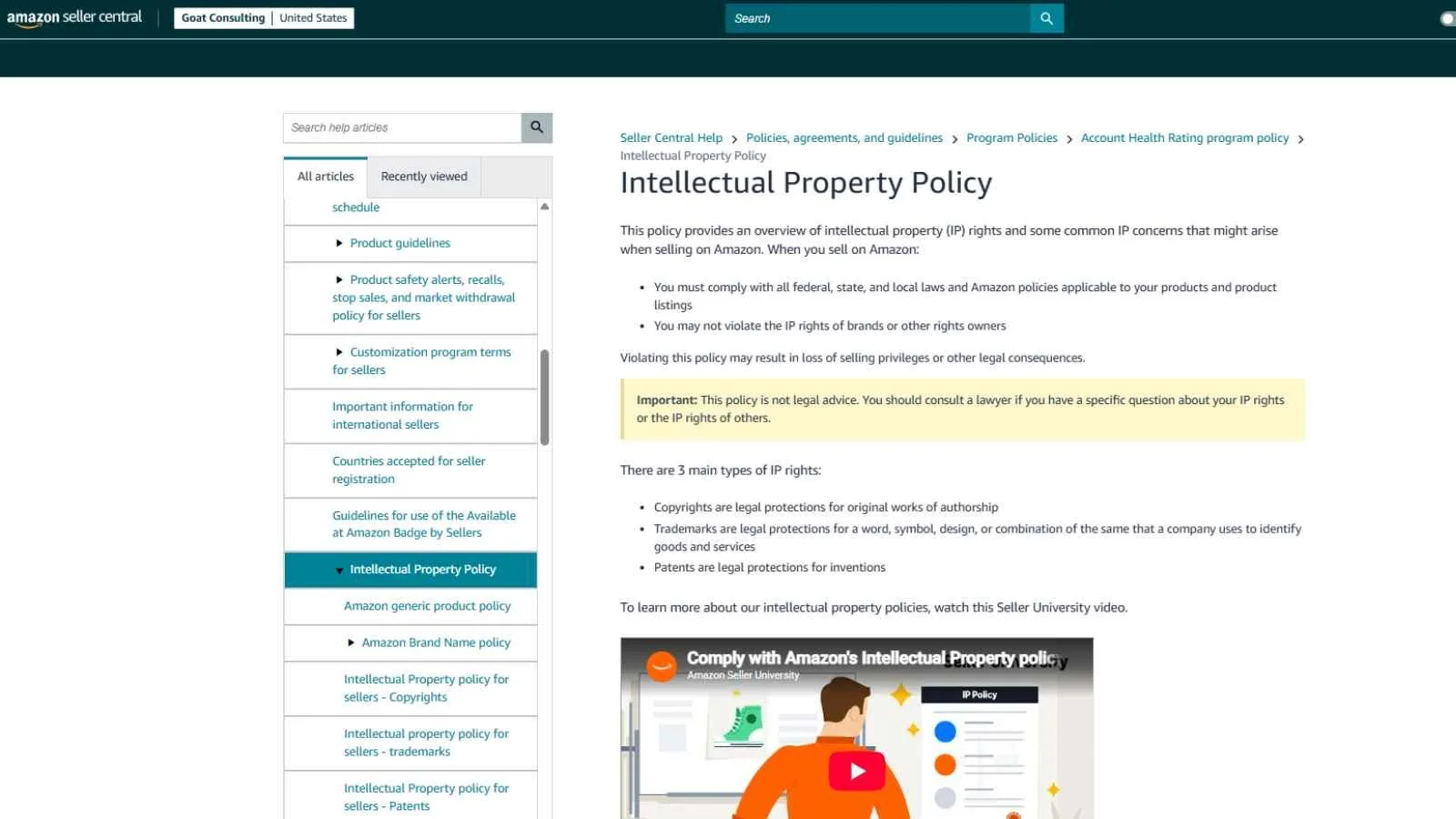
Amazon's enforcement focuses on three types of intellectual property rights. Knowing which one your complaint is about determines how you respond.
Copyrights protect original works of authorship, like the text, photos, videos, and audio that go on a product detail page or in a listing. Using someone else's product photo without permission is a copyright issue.
Trademarks protect words, symbols, designs, or any combination of those that a company uses to identify its goods and services. This category includes counterfeit complaints, where a product is being passed off as a branded product it isn't.
Patents protect inventions. If your product is a copy or replication of something someone else has patented, that's a patent issue.
Each type has slightly different documentation requirements and a different appeal path inside Seller Central. The notice you receive will identify which type Amazon is enforcing, so read it carefully before you take any action.

Common Reasons Amazon IP Complaints Get Filed
In our experience working with sellers at Goat Consulting, most IP complaints fall into one of a handful of patterns. The most preventable one is what we call the brand-name compatibility trap.
When you list a product that works with another brand's product, you can mention compatibility, but you can't claim similarity. Amazon spells this out clearly in its own seller education content. You can say your product is compatible with a branded product, but you cannot list it with phrases like "similar to [Brand]" if it isn't actually that brand. The format Amazon recommends is:
Your Brand name: Product compatible with [Trademarked Brand]
So calling your phone charger "Apple Charger" is a trademark problem. Calling it "YourBrand: Charger compatible with Apple iPhone" is not. The same rule applies to anything you might position alongside a known brand, from replacement parts and accessories to electronics, kitchen items, and pet products. We see this exact mistake on listings every week.
A real client example. This rule applies even when you have legitimate relationships with the brands or organizations you'd want to position around. One Goat Consulting client, Airborne Athletics, makes the Dr. Dish line of basketball shooting machines used by NBA, WNBA, and NCAA Division I players and coaches. Real partnerships and real customers. Even so, on a public Amazon product detail page those organization names are still trademarks owned by someone else. Putting NBA or NCAA in a title, bullet, or image in a way that implies official endorsement, association, or affiliation creates trademark risk regardless of what's true behind the scenes, because Amazon customers can't see your private agreements from the listing. The careful approach is to focus the copy on what the product does for the athlete and the coach, and to keep specific league marks out of the listing unless you have documented permission to use them in that exact way.
Other common reasons include selling counterfeit or unauthentic products, including authentic products in altered packaging that creates authenticity concerns; using copyrighted images, descriptions, or videos that came from a brand's website, marketing materials, or another seller's listing without documented permission; and creating or sourcing products that copy a patented invention.
Where to Find Your Amazon IP Complaint in Seller Central
Inside Seller Central, go to Performance > Account Health and look under the Policy Compliance section. The IP complaint will appear there with a short description of the issue, the rights owner who filed it, the affected ASIN or ASINs, and a complaint ID number. Performance Notifications (also under Performance) will show a chronological list of the same alert.
Open the notification and read it from top to bottom. The notice will tell you the type of complaint (trademark, copyright, patent, or counterfeit), where the alleged infringement appears (on the product, on the packaging, or on the product detail page), and what Amazon is asking you to do. The instructions Amazon provides inside the notification are the ones you should follow first, because each notice type has slightly different requirements.
Your Three Response Options Under Amazon's Policy
If you believe you haven't violated the policy, Amazon's Intellectual Property Policy and seller education videos lay out three specific paths you can take. Picking the right one for your situation is what separates a quick reinstatement from a drawn-out back-and-forth with Amazon's policy team.
Appeal. You request reinstatement by correcting the listing to bring it into compliance with the IP policy. This option does not require invoices or letters of authorization. It's the right choice when the complaint is on the product detail page itself, like a trademark used incorrectly in a title or bullet point, and you can fix the page so it no longer infringes.
Dispute. You challenge an incorrectly placed IP violation by providing evidence such as a letter of authorization, a licensing agreement, or invoices proving the authenticity of your product. This is the right choice when you have permission to sell the brand or use the IP and Amazon needs documentation to confirm it.
Acknowledge. You agree with the violation, agree not to modify the affected listings, and delete them. This is the right choice when you've identified that you genuinely don't have rights to sell the product and the cleanest path forward is to remove the offer.
Submitting an appeal lives inside the Account Health page. You select the policy violation, click Submit appeal, and follow the prompts. Amazon will review the submission, may verify information with your supplier, and reinstate the listing if approved.
First 24 Hours: What to Read, Pull, and Decide
The first day after an IP complaint is when most sellers either set themselves up for a clean reinstatement or accidentally make things harder. Here's the work to do.
Read the notification carefully and note the complaint type, the affected ASINs, the rights owner's name, and the complaint ID. Identify the rights owner and check whether you have any existing relationship with them, like a distributor agreement or an authorized-seller letter. Pull the documentation you have on hand, including invoices from your supplier (you can redact pricing if you like), Amazon order IDs if you sourced through Amazon, and any letters or licensing agreements signed by the rights owner directly.
Then decide which response track makes sense. If the issue is on the product detail page and you can correct the language, choose Appeal. If you have legitimate rights and just need to prove it, choose Dispute. If you don't have rights and probably shouldn't be selling the product, choose Acknowledge and move on.
If you would rather not navigate this alone, this is one of the things our Amazon compliance and listing reinstatement team handles for clients. We've worked with sellers across many of the IP complaint patterns and can help you decide which response track makes sense for your specific notice.
What Documents Amazon Actually Accepts
Documentation requirements depend on which type of notice you received. Here's how Amazon maps them in its Intellectual Property Policy.
| Type of notice | Required documentation / action |
|---|---|
| Product you never listed | Reply to the notification and let Amazon know you have never listed the reported product. Amazon will investigate. |
| Established relationship with the rights owner | Contact the rights owner who filed the complaint to request a retraction. Content can be reinstated when Amazon receives the retraction. |
| Trademark or counterfeit infringement on the product or packaging | Use the Account Health Dashboard to provide an invoice or Order ID that demonstrates product authenticity. |
| Trademark or counterfeit infringement on the product detail page | Modify the product detail page to remove the infringement, then submit your appeal in Account Health. If you believe the listing was removed in error, submit your appeal with supporting documentation like a letter of authorization or licensing agreement. |
| Patent infringement | Reply to the notification with specific reasons why you believe a mistake was made. You may also provide a court order showing your product is non-infringing or that the patent is invalid or unenforceable. |
| Copyright infringement | File a Digital Millennium Copyright Act counter-notice to the email in the copyright warning. The counter-notice must include a sworn statement, identification of the removed material, your physical or electronic signature, your contact information, and consent to the relevant federal court's jurisdiction. |
A few rules apply across all of these. Letters of authorization must come directly from the rights owner. Amazon will not accept a forwarded email as a letter of authorization, and the document needs to be signed or stamped by the brand or manufacturer to be valid. Invoices should clearly show your supplier, the products you purchased, and dates that align with the complaint window. You can remove pricing information if you want, but the rest of the invoice needs to be readable. Amazon order IDs for products you bought through Amazon also work as proof of authenticity in some cases.
If your account has been suspended because of multiple IP infringement notices, Amazon's policy specifies that an appeal needs to include a list of the allegedly infringing ASINs along with at least one of: invoices proving authenticity, Amazon order IDs, an authorization letter from the rights owner that is not a forwarded email, or a court order.
When and How to Request a Retraction from the Rights Owner
If you have a license, an authorized-seller agreement, or another relationship that allows you to use the IP identified in the complaint, the cleanest fix is often to contact the rights owner who filed the complaint and ask for a retraction. Amazon's policy says explicitly that your content can be reinstated if Amazon receives a retraction from the rights owner.
The contact information for the rights owner is included in the original notification. Reach out professionally and concisely. Identify yourself, reference the complaint ID, briefly explain why your listing is not infringing (you have a current authorization, the product is authentic, the IP was used correctly), and ask if they would be willing to withdraw the complaint. Attach any documentation that supports your case.
Two notes to set realistic expectations. First, the rights owner is not required to respond. Some respond within hours, some never respond at all. Second, you can also appeal or dispute through Seller Central in parallel while waiting for the rights owner. The two paths are not mutually exclusive.
For copyright complaints specifically, Amazon also allows you to file a counter-notice under the Digital Millennium Copyright Act. This is a more formal legal step that includes a sworn statement, your physical address, and consent to a specific federal court's jurisdiction. The DMCA counter-notice is rare for everyday seller cases, but it exists for genuine copyright disputes and Amazon's policy spells out exactly what it must contain.
When You've Received Multiple IP Warnings
A single complaint is a different conversation than multiple complaints. If your account has accumulated several IP infringement notices, Amazon may suspend your selling privileges and ask for a formal Plan of Action to reinstate the account. This is the scenario where the longer-form Plan of Action language that you read about online actually applies.
A Plan of Action at this stage needs to do three things. It needs to identify the root cause of the complaints, like sourcing from an unauthorized supplier or using a brand's images on detail pages without permission. It needs to detail the immediate corrective action you're taking, like removing affected listings, securing letters of authorization, and updating compliance processes. And it needs to commit to a forward-looking prevention plan, like authorized-supplier contracts, content audits, and Brand Registry enrollment.
If you find yourself at the multiple-complaint stage, the urgency is real. Amazon's policy notes that Amazon terminates the accounts of repeat infringers in appropriate circumstances, and the appeal process for a suspended account is more involved than for a single ASIN complaint. The mechanics are documented in Amazon's Reinstate selling privileges process, and a clean Plan of Action is the difference between getting back in business and starting over.
How to Avoid Amazon IP Complaints in the First Place
Most IP complaints we see at Goat Consulting are preventable with a few habits.
If you own your brand, enroll in Amazon Brand Registry. Brand Registry gives Amazon the data it needs to verify your trademarks, blocks bad actors before they can copy your listings, and gives you access to tools like Report a Violation and Project Zero. According to Amazon's 2024 Brand Protection Report, Amazon's proactive controls blocked more than 99 percent of suspected infringing listings before a brand ever had to find and report them.
If you sell other brands' products, get an authorization letter signed by the rights owner before you list. Amazon's policy is explicit that the letter cannot be a forwarded email, so confirm the document with the brand directly and store the original signed copy. Audit the images and descriptions you use on every listing, since copyrighted images sourced from a brand's website are one of the most common avoidable complaints. Use the "Your Brand name: Product compatible with [Trademarked Brand]" format whenever your product works with another brand. Source authentic products from suppliers who can document their relationship to the brand, and keep manufacturers' original packaging intact.
For all of the above, the underlying point is the same. Amazon customers expect that what's listed on the page is exactly what shows up at their door, and the IP rules are how Amazon protects that expectation. Operating cleanly on the IP side keeps your account healthy, keeps your listings live, and keeps customers happy with the product they bought.
Frequently Asked Questions - Amazon IP Complaint
-
An Amazon IP complaint is a notification that a seller's product or product detail page may infringe on a copyright, trademark, or patent owned by another party. Rights owners file complaints through Amazon's Report a Violation tool or Public Notice Form. The complaint appears in the Account Health dashboard and may suppress the listing or impact sales until it is resolved through the appeal, dispute, or acknowledge process inside Seller Central.
-
Open the notification in your Account Health dashboard and read the type of complaint. You have three response options. Appeal by correcting the listing, dispute the complaint with evidence like a letter of authorization or invoice, or acknowledge the violation and delete the affected listing. Submit your response by selecting the violation in Account Health and clicking Submit appeal, then upload the documentation Amazon requires for that complaint type.
-
If your initial appeal is denied, you can submit a follow-up appeal with stronger documentation through the same Account Health page. For complex cases, sellers can request review by an Account Health Specialist. For copyright complaints, sellers also have the option to file a Digital Millennium Copyright Act counter-notice through the email provided in the original copyright warning, which includes specific legal requirements like a sworn statement and consent to a federal court's jurisdiction.
-
An Amazon IP complaint can impact your offer in several ways depending on the type of complaint. The listing may be suppressed, the offer may be removed, or sales may be reduced while the complaint is unresolved. The exact impact depends on whether the complaint targets the product, the packaging, or the product detail page, and whether the complaint applies to a single ASIN or multiple listings on the account.
-
In our experience working with sellers at Goat Consulting, valid IP complaint appeals typically take between one and seven business days for Amazon to review, with simple appeals such as correcting a product detail page tending to resolve faster than disputes that require document verification. Amazon does not publish an official service-level agreement for IP complaint appeals, so the actual timeline depends on the complaint type, the documentation provided, and the volume Amazon is processing at the time.
-
Yes, an Amazon IP complaint that was filed in error can usually be removed in one of two ways. First, you can contact the rights owner who filed the complaint and ask them to retract it, since Amazon will reinstate the content if a retraction is received. Second, you can submit a dispute through Account Health with supporting documentation, like a current letter of authorization, a licensing agreement, or invoices showing product authenticity, and Amazon will re-evaluate the notice.
Amazon IP Complaints Conclusion
Receiving an Amazon IP complaint is stressful, but the response process is more structured than most sellers realize. Read the notification carefully, identify the complaint type, pull your documentation, and pick the response track that fits the situation: appeal to correct, dispute to defend, or acknowledge to remove. Most issues resolve once you provide Amazon what its policy actually asks for, which is documented permission, authentic invoices, or a corrected listing.
For prevention, the most effective moves are Brand Registry enrollment if you own your brand, secured letters of authorization if you resell, and the "compatible with" format for any product positioned alongside a known brand. Keeping clean documentation up front is far easier than scrambling for it after a complaint lands.
This post is general guidance based on Amazon's Intellectual Property Policy and is not legal advice. Amazon's own policy notes that you should consult a lawyer for specific questions about your IP rights or the IP rights of others. If your account has been suspended, the response stakes are higher and a qualified Amazon consultant or attorney can help you build a Plan of Action that addresses your specific situation.
About the Author - Reed Thompson
This post was written by Reed Thompson, the CEO at Goat Consulting. Reed helps lead the Goat Consulting team and their clients sell on Amazon by increasing sales, mitigating risk, reducing costs, and solving problems. With years of experience helping brands respond to IP complaints and work through Amazon's Account Health policies, Reed has seen the response patterns that lead to clean reinstatements and the mistakes that draw the process out. If you've received an IP complaint and want help building your response or assistance with other aspects of selling on Amazon, please reach out through our Contact Us form.
Disclaimer - The information provided in this article is informational; it is not legal advice, and should not be relied upon as legal advice. We cannot guarantee that the content will always reflect the latest updates to Amazon policies, local, state, and federal legal advice. This information is not a substitute for reading and understanding policies and regulations.