Amazon Refrigerant Questions for Dangerous Goods Listings
This post covers Amazon's new refrigerant questions, which become required on October 26, 2026 when you create or edit a listing for a refrigerator, freezer, air conditioner, or similar product, and how to answer them without getting your inventory held in a dangerous goods review.
Here's the short version. Starting October 26, these listings ask whether the unit comes pre-charged with refrigerant, which refrigerant it uses, its refrigerant code, and how much refrigerant it holds by volume and by mass in grams. Amazon uses those answers to classify dangerous goods and decide how the product can ship. Pull the code and charge weight from the nameplate or spec sheet before your next edit.
What Amazon Announced for October 26
Amazon announced on September 25, 2026 that listings in four product categories will require new compliance questions starting October 26, and refrigerant appliances are the category this post focuses on. According to the Seller Central announcement, the questions exist to identify dangerous goods, open up more shipping methods, and cut disposal costs and fees that didn't need to happen.
If your listings are already live, nothing happens to them on October 26 itself. Amazon says existing listings don't need any action before that date, and the questions will appear the next time you edit the listing. For an appliance seller, that means the real deadline is whenever someone on your team next changes a title, a bullet, or an image. If you'd rather have the answers lined up before that happens, our Amazon compliance services team runs this kind of catalog audit.
The Other Three Categories in This Update
The same announcement covers shock absorbers and suspension lift supports, markers and writing instruments, and pool and spa water treatment chemicals. Markers ask for the ink base and marker type plus a certification that the product meets a dangerous goods exception, and shock absorbers ask for the shock-absorbing material type along with the same certification.
Pool chemicals get the most specific questions: whether the product contains more than 80 percent trichloroisocyanuric acid, whether its net mass of that ingredient is over 1 kg, and whether each unit is individually wrapped. Chlorinating tablets can also be registered pesticides with the Environmental Protection Agency (EPA), so pool chemical sellers may have Amazon's pesticide rules to meet as well, which we cover in our Amazon pesticides policy guide.

The Five Amazon Refrigerant Questions and Where to Look
Amazon's refrigerant questions ask whether there's refrigerant in the sealed system, what it is, and how much of it there is. The fields come from Amazon's dangerous goods required information page, and here's what each one means and where the answer usually lives.
| Amazon field | What it's asking | Where to find the answer |
|---|---|---|
| Has Pre-Charged Refrigerant | Whether the unit ships with refrigerant already in it and ready to use | Product manual or manufacturer spec sheet |
| Refrigerant Type | The type of refrigerant, chosen from Amazon's list | Nameplate, manual, or spec sheet |
| Refrigerant | The refrigerant code, such as R-32 or R-290 | The plate on the back, bottom, or inside a panel of the appliance, or the manual |
| Refrigerant Volume | Total volume of refrigerant, with the unit of measure | Manufacturer spec sheet, or ask the manufacturer in writing |
| Refrigerant Mass | Total refrigerant charge, selected as a range in grams | Nameplate or spec sheet charge weight, converted to grams if listed in ounces or pounds |
Refrigerant Mass is the field to spend time on, because Amazon wants a range in grams and the number decides how federal shipping rules treat the unit (covered below). If your spec sheet lists the charge in ounces or pounds, convert it, and if it doesn't list the charge at all, ask the manufacturer for the figure by model in writing and keep it with your safety data sheet so the number you enter matches your documents.
Why Amazon Is Asking About Refrigerant Now
Amazon is asking because the refrigerants going into new appliances changed. EPA rules that took effect January 1, 2025 cap the global warming potential, a measure of a refrigerant's climate impact, at 700 for newly manufactured or imported window and portable room air conditioners and residential dehumidifiers, and at 150 for household refrigerators and freezers, according to EPA's Technology Transitions restrictions by sector.
R-410A, a long-standing room air conditioner refrigerant, has a global warming potential of 2,088, so it doesn't fit under the new cap. EPA lists R-32 refrigerant (675) and R-290 refrigerant, which is propane (3), as acceptable substitutes for room air conditioning, and R-290 for household refrigerators and freezers too.
Both carry flammability safety classes from the American Society of Heating, Refrigerating and Air-Conditioning Engineers (ASHRAE): A2L for R-32 and A3 for R-290. EPA also lets products made before the deadline keep selling for three years after it, so your catalog can hold older and newer models side by side with different refrigerants inside.
Common Refrigerants and Their Safety Classes
| Refrigerant | Global warming potential | ASHRAE safety class | EPA status in household appliances |
|---|---|---|---|
| R-134a (HFC-134a) | 1,430 | A1 | Unacceptable in new household refrigerators and freezers as of January 1, 2021 |
| R-32 (HFC-32) | 675 | A2L | Acceptable with use conditions in residential air conditioning |
| R-290 (propane) | 3 | A3 | Acceptable with use conditions in self-contained room air conditioners and household refrigerators and freezers |
How Refrigerant Answers Affect Shipping and FBA
Your refrigerant answers matter because federal hazardous materials rules exempt appliances with non-flammable refrigerant in every shipping mode, but exempt most flammable-refrigerant appliances only on the ground. Under the Code of Federal Regulations at 49 CFR 173.307, refrigerating machines, including dehumidifiers and air conditioners, with 12 kg or less of non-flammable gas aren't subject to the hazmat rules at all.
Flammable gas gets the same 12 kg exception "except when offered or transported by air," and the rule groups A2L refrigerants with flammable refrigerant gases in a separate ground-only exception. The one exception with no air limit is for 100 g or less of a flammable liquefied gas.
Our read is that this is why Amazon wants the refrigerant mass in grams and why its announcement mentions enabling more ship methods: the type and the charge tell Amazon which exception a unit falls under. A unit that doesn't qualify is regulated as UN3358, refrigerating machines containing flammable liquefied gas, a Class 2.1 flammable gas.
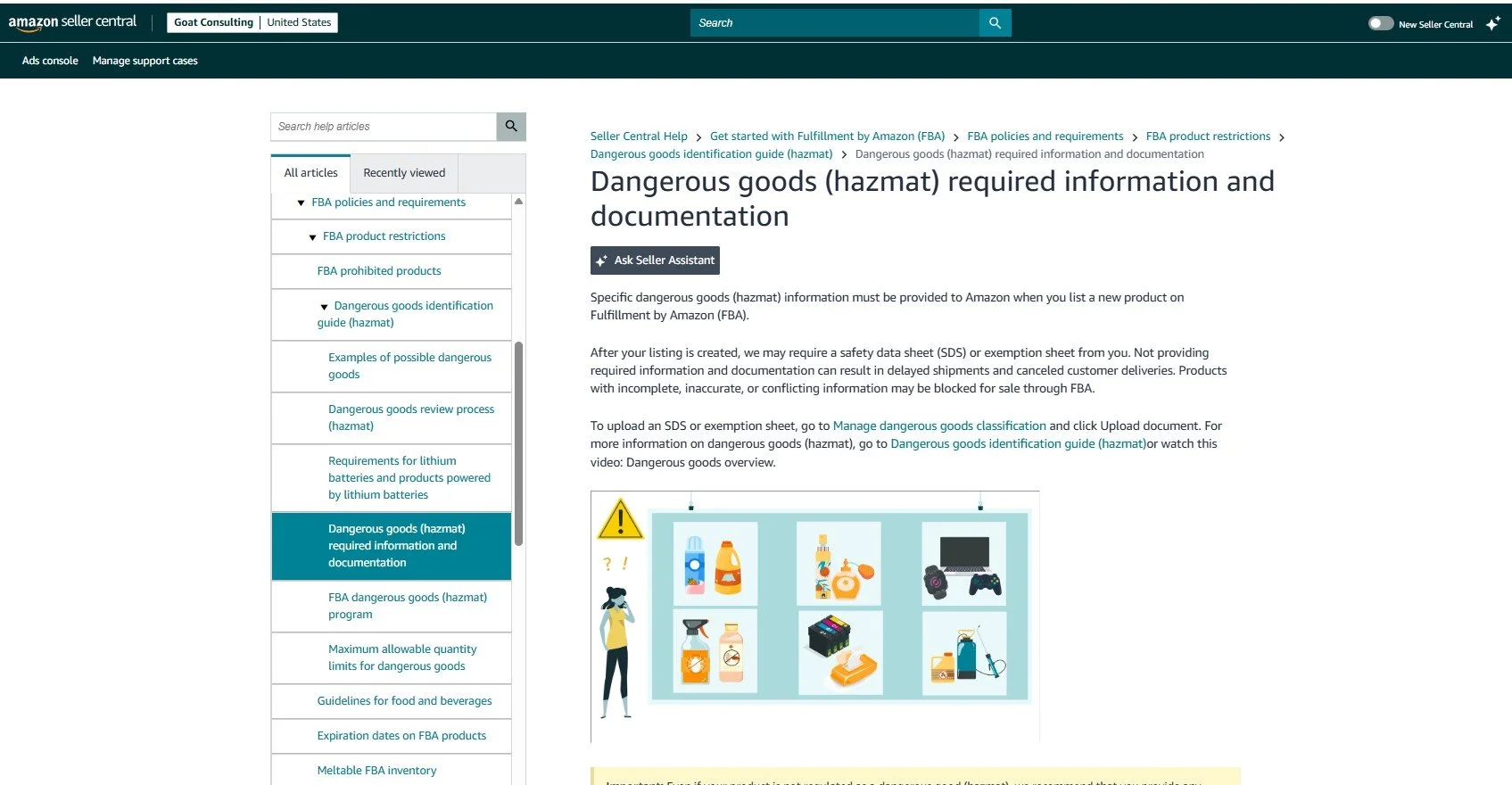
On the Fulfillment by Amazon (FBA) side, the dangerous goods team classifies products within two business days when the information is complete, and every resubmission adds another two business days. Products with incomplete, inaccurate, or conflicting information can be blocked for sale through FBA. If you're weighing FBA against other options for large appliances, our Amazon shipping and fulfillment team can help you compare them.
What to Do Before You Edit a Refrigerant Listing
Get the documentation and details in place before anyone touches the listing, and make sure your documents, the dangerous goods answers in the backend of the listing, and the detail page customers see all say the same thing. That's the first thing we tell sellers in this category, because Amazon's help page is explicit that conflicting information can get a product blocked.
List every ASIN (Amazon Standard Identification Number) in the category and record each model's refrigerant code. Treat model years separately, since a unit built before the EPA deadline can use a different refrigerant than its replacement.
Get the refrigerant charge for each model from the manufacturer in writing, in grams.
Get a current safety data sheet (SDS). Amazon requires one dated within five years, with all 16 standard sections, showing the same product name and brand as your detail page.
Don't plan on the exemption sheet. Amazon accepts it only for battery products and products without harmful chemicals, and rejects it for anything else.
Check variation families child by child, and for a bundle or kit with more than one chemical-based product, have an SDS for each.
Make sure the title, brand, and any refrigerant named in bullets, images, or specifications match the SDS and your answers.
Edit during a slower sales period, then confirm the classification in the Look up an ASIN tool on the Manage dangerous goods classification page.
If you'd like a hand with the audit, our Amazon compliance team runs these audits for manufacturers and brands.
What Goes Wrong With Amazon Dangerous Goods Reviews
The costly failure is stranded inventory: the offer sits in Amazon's catalog but isn't available for sale, so every day in review is a day of missed opportunity and lost sales. That's the pattern we see when a product gets pulled into a dangerous goods review, and the cost is the same whether the flag was right or wrong.
Clients we have engaged with describe the same frustrations repeatedly. Some learned about a hold only when inventory showed as reserved or an order came back as unfulfillable hazmat. Others uploaded an exemption sheet, waited, and were told an SDS was required, which restarted the review. One seller couldn't create a removal order during review, and another had products cleared as non-dangerous that stayed unavailable until a case was opened.
Automated classification also catches products that only resemble the regulated item. A seller of refrigerator replacement parts described parts being restricted under Amazon's EnergyGuide label rules as if they were complete appliances, so if you sell parts or accessories, watch for refrigerant questions showing up where they don't belong.
Timing matters once inventory is already in a fulfillment center. If Amazon identifies a possible dangerous good there, you get 14 business days to provide documentation, and after that the inventory is disposed of at your expense. Ask your manufacturer to tell you before any refrigerant change between production runs so your answers stay accurate. For a product that's already been flagged, our guide on how to fix hazmat or dangerous goods issues on Amazon walks through the appeal.
Amazon Refrigerant Questions FAQ
-
No. Amazon says sellers with existing listings in these categories don't need to take action before October 26, 2026. The refrigerant questions appear the next time you create or edit a listing, so the practical deadline is your next edit. Gathering refrigerant codes, charge weights, and a current safety data sheet now keeps that edit from stalling.
-
Not automatically. A flammable refrigerant changes how the unit is treated in transport, and Amazon's dangerous goods team decides how the product is classified after reviewing your answers and documents, usually within two business days when the information is complete. Answer accurately. A wrong answer given to avoid a flag creates a larger problem later.
-
Check the plate on the back, bottom, or inside a panel of the appliance first, since that's where Amazon says the refrigerant code usually appears. The product manual and manufacturer spec sheet are the next places to look. If the charge weight isn't listed, ask the manufacturer for it in grams, in writing, for each model you sell.
-
Amazon's announcement names refrigerators, air conditioners, and freezers and adds "similar products" without a full list. Federal shipping rules define refrigerating machines to include dehumidifiers and air conditioners. If your product ships with a compressor and pre-charged refrigerant, we'd plan on seeing the questions and prepare the same documentation.
-
The announcement applies to anyone who creates or edits a listing in these categories and doesn't limit the questions to Fulfillment by Amazon. Amazon's documentation page is written around FBA, where the answers drive the dangerous goods review. Answer the questions accurately either way, because the listing can't be saved without them.
-
Amazon can ask for a safety data sheet or block the product for sale through FBA until the information is complete and consistent. Each resubmission adds two business days of review. If inventory is already in a fulfillment center, you have 14 business days to provide documentation before Amazon disposes of it at your expense.
Getting Refrigerant Listings Ready for October 26
Amazon's refrigerant questions are short, but the answers, meaning the refrigerant code and the charge in grams, decide how a unit can ship, and the EPA transition has put flammable refrigerants into many new models. Run the catalog audit before your next listing edit, get charge weights and a current SDS from your manufacturer, and make sure the documents, the backend answers, and the detail page agree. That keeps offers available for sale instead of sitting in review.
This post is general information about Amazon's policies and federal rules as of September 28, 2026, not legal or regulatory advice. Amazon changes its dangerous goods requirements often, so confirm the current requirements in Seller Central and with your manufacturer before relying on them.
About the Author - Will Tjernlund
This post was written by Will Tjernlund, the CMO and co-founder at Goat Consulting. Will helps lead the Goat Consulting team and their clients sell on Amazon by increasing sales, mitigating risk, reducing costs, and solving problems. He built the Amazon channel at his family's manufacturing business, Tjernlund Products, where the team had to solve dangerous goods (hazmat) issues of its own, and our Amazon compliance services team now helps manufacturers get classification and documentation right before it costs them sales. If you want help answering Amazon's refrigerant questions and getting appliance listings through dangerous goods review, or assistance with other aspects of selling on Amazon, please reach out through our Contact Us form.